By Elena Johnson CVC AC
It takes 25 hours to form an egg, 18-20 of those hours is spent on shell formation.
In those hours, the hen uses and replaces the calcium carried in the bloodstream up to 100 times. The calcium required to make shells must be provided in the hen’s diet as fast-released and slow-released calcium. Carbonate is naturally made through normal metabolism, but Calcium Carbonate must be broken down into its components of (calcium + carbonate) in the intestines before the calcium can be absorbed into the blood. The calcium is then either stored in the bones or routed to the shell gland through the bloodstream.
In several studies, hens sought out oyster shell late in the day, prior to the most rapid period of shell formation, which is overnight, in order to have a continuous supply of calcium.
There are two types of calcium used for poultry. Crushed limestone, which is fast-release because of its small particle size and Oyster Shell, slow-release because of its large particle size and it sits in the gizzard, getting ground up a little at a time.
Slow-release is very important because eggshells are formed at night when the hen is sleeping and not consuming calcium. It only takes 90 minutes for food particles to pass through a chicken. Bigger particles take much longer which is why Oyster Shell is so important because they provide more calcium at night when the hen is not eating.
Commercially produced layer feed already contains Crushed Limestone which is fast-released calcium, so feeding crushed eggshells is unnecessary and redundant causing the hens body to work harder to filter out the extra calcium which is taxing to the kidneys.
Oyster Shell is heat treated to kill any bacteria and feeding crushed eggshells that have not first been baked at low temperatures to kill bacteria can be harmful to your hens.
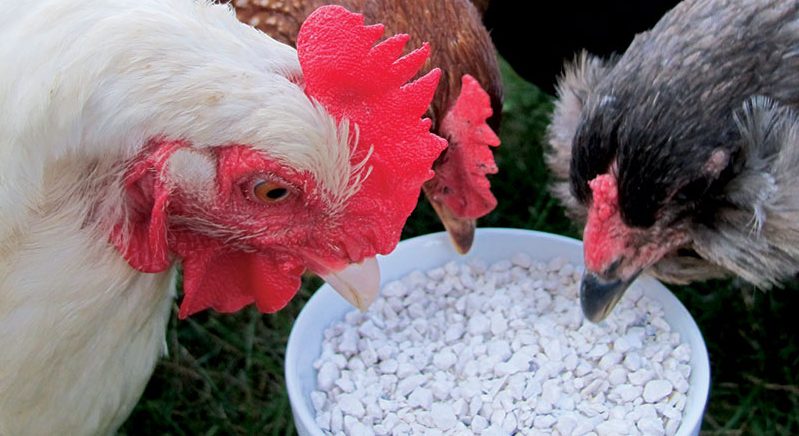
Oyster Shell should be available at all times in a separate feeder to provide the slow-released calcium hens need for proper eggshell formation. You should start providing oyster shell at 18 weeks of age before pullets begin to lay so they have the calcium needed to make eggshells. Not giving it before they start to lay is why many have odd, no shell, rubber eggs when first starting to lay. And it’s very important to always provide oyster shell throughout their laying lifetime for strong eggshells.
If your feed says it contains Oyster Shell, it is NOT a replacement for the plain chunks of Oyster Shell as it is ground into a fine powder to be processed into the feed which then makes it fast release calcium like ground limestone. Size does matter. It MUST be the chunk Oyster Shell to provide slow-release calcium because it stays in the crop much longer to supply calcium over night when the eggs are going through the shell phase of development. You will also notice on the bag of oyster shell it contains Coral Calcium, this is also a source of slow-release calcium and is in almost all Oyster shell which works the same way. The importance being the size of the chunk compared to a powder which is ground and passes through the system quickly. When chickens eat, it only takes 90 minutes for the food to completely pass through the digestive system. Oyster Shell in chunks (pellets) stays in the crop and takes all night to grind up and digest which is why it is slow release.
Here are some reasons for soft shelled eggs.
1. Age, young pullets, older hens
2. Calcium deficiency, Vitamin D or Phosphorus
3. Stress
4. Environmental stress, ie: high ammonia in the coop from not cleaning, overcrowded, predators.
5. Heat stress, panting to try to stay cool.
6. Rooster stress, over mating. 8-10 hens per rooster.
7. Illness, infection or virus. Infectious bronchitis-affects the respiratory, reproductive and urinary systems. Osteoporosis and Osteomalacia-soft fragile bones.
8. Drug residue-caused from using sulfonamide
Since we’re talking eggs, here’s an interesting fact, all eggs start out white, it is exposed to pigments on the way through the oviduct. All colors except blue are only on the outside of the egg. Blue eggs owe their color to oocyanin, a pigment that permeates the eggshell so that both the outside and inside are the same shade of blue.
Sources:
https://cs-tf.com/chicken-laying-soft-eggs/
https://www.redalyc.org/journal/3031/303160553042/html/
 RVO Vet Corner Files
One thought on “Oyster Shell Soft Shelled Eggs”
Comments are closed.