Marek’s Disease.
Marek’s disease (MD) is a herpesvirus-induced neoplastic disease of chickens characterized by infiltration of various nerve trunks and/or organs with pleomorphic lymphoid cells. It’s observed mostly in chickens and occurs most commonly in young, sexually immature chickens (2-7 months old) but can occur at basically any age after 3 weeks old.
A Marek’s Disease diagnosis cannot be made through a photo – the only way to know if a bird has Marek’s or not is having the bird tested. Marek’s, ALV and REV all share a lot of the same symptoms and appear nearly identical in a necropsy. You need to have a PCR test done which is run on a blood samples. The test can be ordered via Research Associates Lab (vetdna.com), order the collcection kits from RAL, collect the samples as per directions from a toenail and send it to the lab. Once you have the results, post them in the our Chicken Vet Corner group.
This virus is a cell-associated alpha herpesvirus classified into three serotypes.
- Serotype 1 isolates are ubiquitous in chickens and pathotypes vary from very virulent plus (vv+) (oncogenic) to nearly avirulent (mild).
- Serotype 2 isolates are common in chickens and are nononcogenic.
- Serotype 3 isolates, also known as turkey herpesvirus, are ubiquitous in turkeys and are nononcogenic.
From our Approved Contributor Chris Schoedel
“There are 3 serotypes of Marek’s vaccine currently being made. Serotype 1/Rispens, Serotype 2/IBD, and Serotype 3/HVT. The first 2 provide the best protection against the virus, and are not leaky. Unfortunately, they need to be stored in liquid nitrogen, and thus are not available to us backyard flock owners. Some hatcheries use them, some don’t.
Serotype 3/HVT needs to be stored at refrigerator temps, and is the only one we backyard flock owners can buy. This one is a live virus – but not one that can infect chickens. It’s a strain of virus that infects turkeys. It’s used as a vaccine for chickens because the turkey strain of the virus is similar enough to chicken ones that the antibodies give chickens a pretty good chance of resisting Marek’s if they’re exposed to it. It’s leaky – but that doesn’t mean what a lot of folks think. It does not automatically make a bird a carrier. What’s meant by “leaky” here is that a small but nonzero number of chickens given this vaccine will not be able to resist infection, but will have enough resistance to suppress symptoms. In this case, the bird becomes an asymptomatic carrier – but this is rare.”
Different types of Marek’s Disease:
- Neurological form: lymphoid infiltration into the peripheral nerves. Cervical nerve involvement can cause wry neck, neck paralysis, head tilt. Vagus nerve can cause crop emptying issues or breathing difficulty. Up to 20% mortality.
- Transient paralysis form: temporary incoordination (ataxia) or complete paralysis of next or legs, lasting 1 to 2 days. Up to 30% mortality.
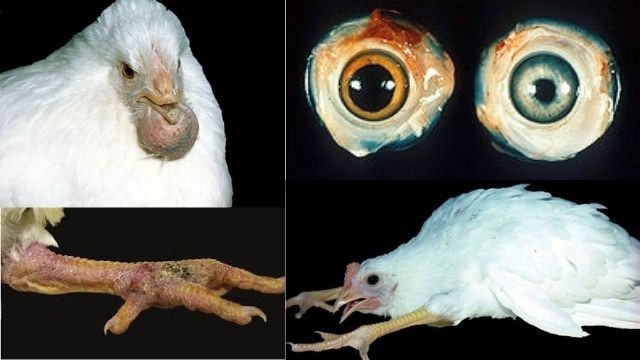
- Ocular form: lymphoid infiltration into eyes, causing change in iris color, pupil shape/size, and partial/total blindness. Up to 25% mortality.
- Cutaneous form: lymphoid infiltration into skin causing enlarged feather follicles. 0% mortality rate.
- Visceral form: tumors develop internally (kidneys, spleen, liver, gonads, heart). Up to 80% mortality.
Transmission: Infected chickens, that may or may not be clinically ill, will shed virus-containing feather follicle dander which will then infect other chickens by respiratory route. Infected dander can be disseminated over long distances. Carrier birds can sporadically shed the virus as well.
Symptoms: The disease is characterized by peripheral nerve enlargement and development of visceral lymphomas that may affect a wide range of organs.
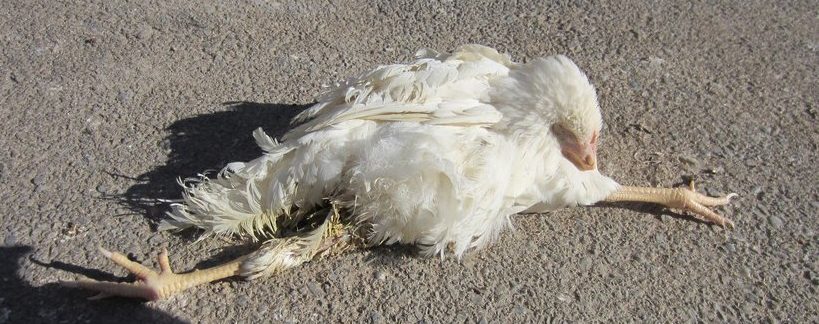
Birds may present asymmetric partial paralysis (paralysis of the legs, wings or neck), dilation of the crop, blindness, lethargy or significant weight loss and muscle loss. It can cause a “gray eye” or “iridescent eye” appearance due to the infiltration of lymphocytes into the iris.
Other symptoms: Torticollis, one leg stretch forward and the other backwards, incoordination, gasping, delayed crop emptying, irregular-shaped pupils, reddened legs, paleness, loss in appetite, weakness.
Diagnosis: Marek’s disease often occurs in 2-5-month-old (sexually immature) chickens but can also occur after the onset of egg production. Outbreaks after the onset of egg production in vaccinated stock have been called “late Marek’s” and are often associated with newer, more highly virulent vv+ pathotypes.
For the diagnosis of Marek’s disease, it is critical to diagnose the tumors and not the infection because MDV is considered ubiquitous within commercial poultry flocks. Usually, diagnosis is based on enlarged nerves and lymphoid tumors in various viscera.
MD can be confirmed in unvaccinated birds by sending a couple of the bird’s feathers to a veterinary diagnostic laboratory for confirmation. If the chicken has already died, sending their body to a diagnostic lab for a necropsy and examination of the tumorous tissues is the best option.
Vaccinated chickens rarely get sick, and should be vaccinated before being exposed to the virus. Birds without the vaccine should not be combined with birds who have been vaccinated.
Chris Schoedel also states “To get chicks with the best chance of not contracting Marek’s, get some that have had the combo of all 3 vaccine serotypes. Some hatcheries list which serotypes they use on their websites, some don’t.”
Prevention: Make sure to purchase immunized flocks (at 18 days of embryonation or at hatching) and minimize early exposure as immunity is not fully developed for 7-10 days. The virus survives for months in poultry houses, so they must be carefully sanitized and disinfected.
Most common vaccines consist of turkey herpesvirus (HVT), a serotype 3 virus as a cell-associated preparation, or a bivalent vaccine consisting of turkey herpesvirus and a serotype 2 virus (SB-1 or 301 B). Attenuated serotype 1 vaccines (CVI988, RM1 and 648A80) are also used. Care must be taken in handling cell-associated vaccines as they are highly susceptible to adverse environmental conditions.
Treatment: There is no treatment for MD. Although no treatment is available, current vaccines are highly protective.
References: MSD Veterinary Manual, Avian Disease Manual: Seventh Edition, https://poultrydvm.com/condition/mareks-disease
**The Vet Corner groups encourage members to establish a relationship with their local veterinarian, don’t wait until an emergency.**
© 2014-2025 Rural Veterinary Outreach. All Rights Reserved.
 RVO Vet Corner Files
You must be logged in to post a comment.