
By Deb Haines
Shedding is different from hair loss. Shedding in goats is regularly observed in the Spring, but tends to be rather inconspicuous and slow. Goats may even go through several shedding stages depending on factors such as day length and weather. Sexual cycle, function of the thyroid and adrenal glands, and nutrition may also be factors.
Goat hair coats consist of the main outer coat of coarse hairs and a fine, downy undercoat. The coarse guard hairs are produced by primary hair follicles and the finer hairs by secondary hair follicles. Sometimes you can help your goat in its shedding process by combing out the undercoat when the weather warms. This may alleviate hair loss in the future when your pygmies decide to rub off that heavy coat.
Hair loss is more noticeable than shedding and falls into several different categories:
* Traumatic hair loss. This includes rubbing hair off (scratching) on a fence or other object, getting caught on something causing hair loss, or other self-induced causes.
* Fungus or parasites. Skin fungi, such as ringworm, causes hair loss by breaking the hair off at the base. Parasites, like lice or mange, cause itching or irritation and goats will scratch or rub until hair loss occurs. Lice are probably the most common external parasite of goats, but mange, caused by sarcoptes scabiei, is not uncommon. Here, the mites burrow under the skin causing irritation, and the goat’s natural response is to scratch or rub against something. In some areas, insect bites can also cause hair loss as a result of trauma. Bacterial and viral infections may also cause hair loss.
Hormonal, or metabolic causes are not as well researched …example= She may experience a big fluctuation in hormones that results in hair loss. Some does “blow their coat” regularly after parturition, during nursing or weaning. Wethers can also get this same effect when they are castrated, causing an estrogen deficiency. Hypothyroidism can also cause hair loss in goats.
Zinc deficiency causes of hair loss in goats. In one study done on Pygmy goats and sheep (Zinc deficiency in sheep and goats: it was noted that wool or hair loss was a prominent clinical sign associated with zinc deficiency. Hair loss was most extensive on the head, neck, flanks, perineal areas, and lower portion of the limbs, hair was thinning areas. The skin thick, dry and scaly and the hair was dull and shaggy.
Many other vitamin or mineral deficiencies can also cause hair loss. Vitamin A deficiency can create a rough, dry coat with a shaggy appearance and dandruff. Copper deficiency can cause a goat’s hair coat to be rough with a “bleached out” appearance. Iodine deficiency can cause hair loss. Selenium poisoning (too much of a good thing only in certain parts of the country) can also contribute to hair loss.
Shots or other medical treatment may cause hair loss at the site of injection or application. This may happen with some parasite control medications.
Another skin condition with hair loss, scaling and crusting around the eyes, lips and chin is called Alopecic Exfoliative Dermatitis in Goats. It was noted that the ears, poll and poorly haired areas of the ventrum and perineum were also affected. It has a fluctuating course and at times may spread to other areas of the body. All ages and both sexes can be affected. For some it would be worse in the summer and others in the winter. They found that in some goats, zinc deficiency also played a role but never found the true cause. It responded well to steroids in most cases.
Regardless of the cause, there are several ways to differentiate between the categories of hair loss. The first step is to look at the surroundings. Are your goats rubbing on a low object or putting their heads into feeders that may be too tight, causing hair loss on the neck or other areas? Stay alert to these possibilities.
Check for parasites. A visual examination is great but a skin scraping will make the diagnosis conclusive. Not all parasites are visible, and a skin scraping may reveal the presence of mites or other parasites. A skin scraping will help you to either eliminate or confirm one diagnosis and allow you to proceed with treatment. You may even discover a secondary bacterial infection or something else you did not suspect.
Another method of elimination is a blood test to look for possible hormone or vitamin/mineral deficiencies. I realize this is more like the shotgun method of diagnosis than the rifle, but many times in veterinary practice the process of elimination is necessary.
One indicator of the source of hair loss may be found in the different patterns of hair loss. Traumatic hair loss is usually on one side or the other – more in one or two different locations. A parasite problem may show a more unilateral hair loss pattern, and a hormone problem usually manifests itself in a more bilateral pattern where the hair loss is equal on both sides.
Treatments vary, so it is important to diagnose the reason. In traumatic hair loss, when goats are rubbing against an object, its important to make sure it is not due to parasites, tight feeders or heads through the fence. In this case, simply modify the environment to alleviate the problem. Some parasite treatments are toxic, so you don’t want to use them if you don’t have to. For some types of hormonal hair loss, sometimes it is best just to wait until the situation has calmed down. Hormone levels are complicated and additional problems can be created by trying to alter them.
In reality, the main focus is to determine the cause and treat the problem. Then, just sit back and wait. The one good thing about hair loss in goats is that it usually grows back.
NOTE….. Skin diseases in goats fall into four categories: bacterial, fungal, parasitic, and viral.
Goats are susceptible to a variety of skin and coat problems that are normally caused by diet and mineral deficiencies. Flaky skin and a dull coat are often symptoms of dandruff, a dry skin condition that causes the outer layer of skin to slough off more frequently than is necessary. Several other conditions, including mange and worms can cause dandruff-like symptoms Rule out other potential conditions. Check for lice, which lay eggs that look like dandruff. Separate your goat’s hair and look at the skin with a magnifying glass. If you see any bugs, odds are good your goat has lice.
Normal Shedding… This is called the undercoat/down/cashmere. brushing can help remove.
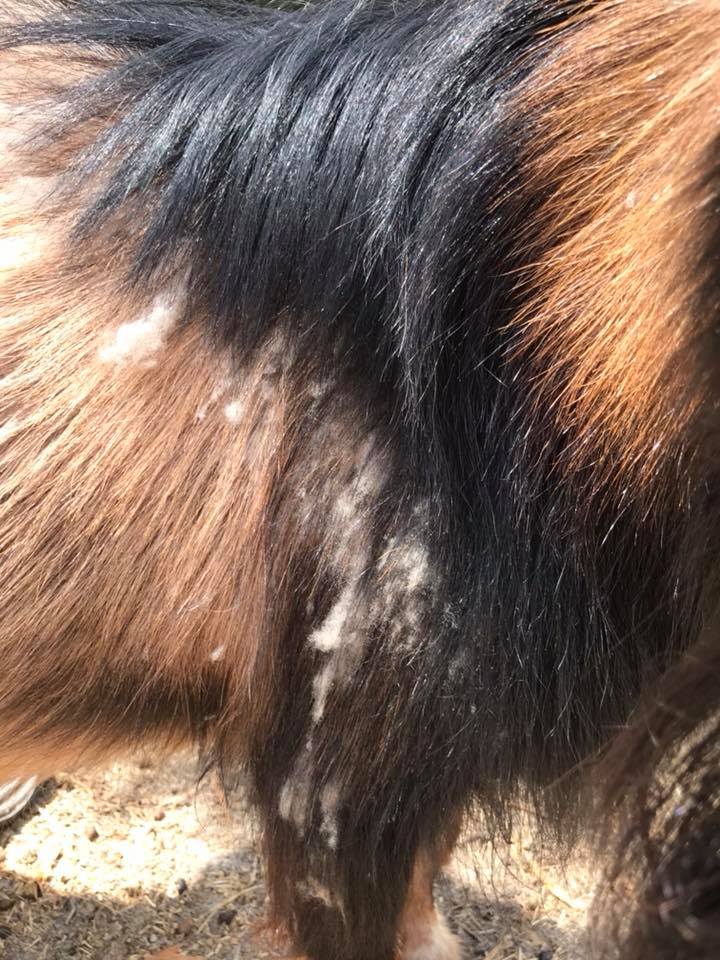
What Might cause Itching ?
What might cause itching with goats? Infestations due to lice, mite, flea, tick, flies or migrating parasites. Mite infestations are important causes of skin disease in ruminants which may initially present as an individual animal or herd problem. Winter time we see a lot more herd problems because the animals are crowded together for warmth. Crowding as you may have already figured out the external parasite much as lice and fleas are easily transferred from one animal to another.
Sarcoptic mange is another external parasite that can cause goats to be itchy. You may know this mite referred to as scabies and is contagious to people as well. While on mange there are a few more in goats that are itchy. The ears are often the locations you see Sarcoptic and Psoroptic mange, while the pastern and limb are seen for Chorioptic mange. Ivermectin or lime sulfur is the treatment of choice for all mite infestations with the exception of Demodex. Goats are infected with Demodex as kids from their dams but lesions may not be noted until animals are over 18 months old. It is an individual animal’s disease and culling is recommended, as there is no satisfactory treatment.
Step Back to lice for a moment….Lice like to congregate around the poll, nose, eyes, withers, and tail head. Pruritus and hair loss are the main clinical signs. Lice or eggs (nits) may be observed on the skin and hairs of the neck and back making diagnosis easy. Ivermectin every 2 weeks for three treatments is effective.
Other external parasites such as biting flies and fleas can be problem for goats and are handled with avoidance techniques. Larval migrations of P. tenuis is a parasite that can cause long areas of dermatitis and is handled with deworming and anti-inflammatories as needed.
HAIR LOSS: Let’s wrap this one up in one paragraph… most likely secondary to pruritus and ectoparasite infestations. Focal areas of hair loss are commonly caused by Dermatophytosis and mites. Widespread hair loss/shedding is usually seen with systemic illness in young goats and is the result of dormancy of the hair growth phase. Other cause hair loss include contact dermatitis, pelodera strongyloides (parasite) and P. tenuis, hypothyroidism and rarely, a kid be born with congenital alopecia.
Staphylococcus pyogenes and S. aureus dermatitis are bacteria that are common in goats. These bacteria are normally on the skin at all times and when the skin is irritated or inflamed form “itching” the bacteria will colonize/enter in the irritated tissue and cause a papular (red spots) and eventually pustules (pimples) infection. We had a good example of a condition called impetigo a while back on the udder. Sometimes after goats freshen they will get a superficial pustular dermatitis (impetigo).
Effects of external parasites
External parasites limit production in sheep and goats in many ways and result in economic loss. The following are some of the major ones:
Attachment to the host causes irritation of the skin with subsequent ulceration and secondary infections.
They feed on body tissue such as blood, skin, and hair. Heavy infestations are associated with anemia (adult female ticks can, for example, suck up to 10 ml of blood).
Cause discomfort and annoyance. Weight loss, loss of condition and reduction in milk production may occur as a result of nervousness and improper nutrition because animals spend less time eating. The wounds and skin irritation produced by these parasites result in discomfort and irritation to the animal.
External parasites can transmit diseases from sick to healthy animals due to their habit of moving from one host to another Some of the transmitted diseases are serious with fatal consequences.
Bites can damage sensitive areas of skin (teats, vagina, eyes, etc.)
How do we know if an animal is suffering from external parasites?
Sheep/goats with an irritated skin will be persistently scratching themselves. They will use their teeth, hind hooves and horns (if they are horned). In extreme cases, affected animals will rub on walls of shelters, fence posts and any solid object they can find.
Remember that most parasitic infections will give rise to a generalized irritation whereas skin diseases will probably be more localized. grating teeth, loss of appetite and shaking the head frequently for seemingly no reason is indicative of nose bot fly infestation. Lesions consist of foul smelling ulcers resulting from severe fly infestation. The ulcers often have a ‘honey combed’ appearance and are filled with larvae (maggots). Decreased feed intake, resulting in decreased weight gains and milk production. Skin damage, hair loss, Scale formation, thickening and wrinkled skin.
Prevention of external parasites
Rather than waiting until the problem of external parasites becomes serious, farmers should maintain a strict preventative regimen to controlling external parasites. Conduct a thorough physical evaluation of your sheep and goats at least once weekly. Run your hand over each animal’s hair coat, visually inspecting for excessive hair loss, flakes of loose skin, areas of skin irritation, and any crusty lesions or bumps that might indicate infection with an external parasite.
Immediately separate and place any animal that shows sign of parasite infection or seems to be unthrifty. This helps to reduce the chances of passing infection on to the rest of your animals
Quarantined animals should not be mixed with the main flock until treatment is complete and the parasite eradicated. Isolate newly introduced animals and treat them for external parasites before mixing them with other animals.
Practice good sanitation habits.
Clean animal houses regularly
Farmers/breeders should also be aware of ways to reduce the number of ticks on pasture.
Rotate the land where livestock graze.
Avoid pasture which has many ticks as long as possible
Chickens can be kept in places where there are many ticks, for example around watering places, etc.
Control by good animal hygiene
If Sheep… Shearing of sheep regularly for lice and keds Shearing and wetting/washing animal regularly with proper detergents can be effective especially against lice
If the above measures are not effective, treat the animals with appropriate pesticide
Lice
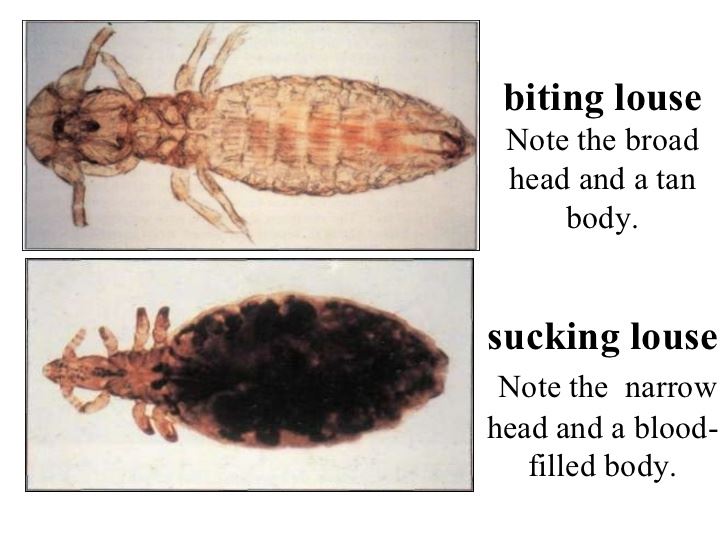
Biting Lice…The goat biting louse Bovicola caprae, Angora goat biting louse crassipes, and limbata are the three main species found on goats. All three species live on the skin surface and feed on hair, skin and detritus. Eggs hatch in nine days to 12 days and on average, the entire life cycle is completed in one month. Biting lice of goats are distributed worldwide with winter populations being the most severe. Optimal control can be achieved with a residual insecticide spray with retreatment in two weeks after the initial treatment.
Sucking lice…
Three species of blood-sucking lice are found on goats: the goat sucking louse Linognathus stenopsis, African goat louse, africanus and sheep foot louse pedalis the goat sucking louse can be dispersed over the entire body of goats and the African goat louse is usually around the head, body and neck regions. Both the goat sucking louse and the African goat louse are bluish-gray in appearance. The sheep foot louse is an occasional pest of goats and can be found on the feet or legs of the animal. These blood-feeding lice species cause the most severe damage. Excessive feeding causes scabby, bleeding areas that may lead to bacterial infection. Mohair on Angora goats may be damaged to the extent value reduction is 10 percent to 25 percent. Control can be obtained utilizing the same methods described for biting lice.
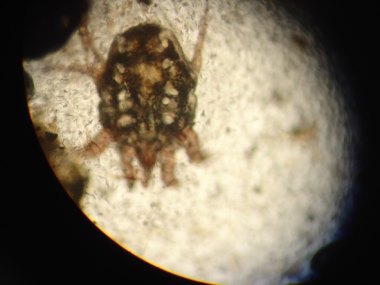
This type of mite commonly called a mange mite, causes tail or foot mange and it does not burrow into the skin. Chorioptes mites are not species specific. Different species of this genus can be found on cattle, sheep and goats and the different species can interbreed with each other. Although the species that usually infect goats is called Chorioptes caprae, it is probably the same as the species that infects sheep and cattle.
Infections of Chorioptes caprae the species that infects goats usually begins on the lower legs, later spreading to the hindquarters. Infections cause itching, and crust and scab formation. The life cycle is very similar to Psorptes mites, but is completed in about 3 weeks.

Infections of Psorptes mites, also known and called mange or scab mites usually start on the shoulders the back or the tail area. These mites prefer areas that are well covered by hair. As the course of the infection develops they will spread to other part of the body. Psorptes cuniculi mites (which at most times affect rabbits) prefer to live inside the ears. This is a very contagious mite.
Psorptes mites do not burrow into the skin. These mites have piercing mouth parts that they use to puncture the skin and to suck lymph. This stimulates an immune reaction by the host and the area swells and serous fluid will seep to the surface creating a crust and scabs. The hair or wool will fall out or the goat will pull it out when biting at the very itchy lesions.
These Psorptes mites do not prefer to live on the bare crusty patches so they will migrate to the edges extending the infection outward. Skin scrapings to identify this mite needs to be made at the edges of the crusty lesions. Long standing infections can cause weight loss. Psorptes mites are identified by their long, segmented pedicles.
The life cycle is typical of most Psorptes mites where the female lays eggs at the edges of crusty lesions hatching in 1 to 3 days. If eggs are laid away from the skin they take longer to hatch or may die. Larvae feed for several days after hatching then molt to a nymph stage. These nymphs will molt in another 3 to 4 days into young females or males where usually there are about twice as many females than males. Mating takes place shortly after the molt and lasts only for 1 day or less. The female mite will molt again about 2 days later then will begin laying eggs in another day. This whole cycle takes only 9 days after she first hatched from the egg. The female will live for 30 to 40 days, laying about 5 eggs every day.
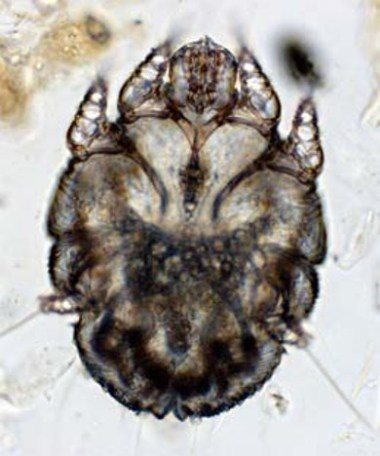
This type of mange mite burrows into the skin often spending the entire life cycle within burrows. Sarcoptes scabe is the species that infects most mammals. An infection begins in hairless regions or regions of short hair usually on the face or ears.
The female Sarcoptes scabe burrows into the skin, and lays 40 to 50 eggs, 4 to 5 a day. The eggs hatch in 3 to 5 days producing six-legged larva. The larva leaves the breeding tunnels and wanders on the skin or remains in the breeding tunnels and develops to the nymph stage. Those that reach the surface may die, or they can make shallow pockets in the skin tissue to feed and molt to several nymph stages which can also wander on the surface and make new pockets or extend the molting tunnels. Adult males and females form about 17 days after the eggs were first laid.
The female remains in her molting pocket until fertilized by a male then extends it into a breeding tunnel, or returns to the skin surface to create a new tunnel and then begins laying eggs. Mature females do not live much longer than a month. Wandering larvae, nymphs and fertilized females spread the infection on the host and to other hosts. They cannot survive off the host for more than a few days.
As they pierce the skin to feed on lymph fluid and skin cells they cause a great deal of irritation, itching, and scratching which worsens the condition. Crusts form on the skin and then the skin becomes thickened and wrinkled and the hair falls out. Lesions in the skin begin to develop in just a few days after infection, but the intense itching typical of Sarcoptic mite infection does not begin for a month or so later. The fecal pellets of the mite are responsible for the host inflammatory response. These mites prefer areas where there isn’t much hair such as the face of goats and ears although in long standing infections the mites can spread to all parts of the body.
The signs include bare skin, which is thick and wrinkled and covered in dry crusts. Early in the infection small raised red bumps and fresh exudates can be seen. To identify these mites in the microscope deep scrapings of skin must be made down to the point of drawing blood. It still might be difficult to find live mites in the burrows.
Sheep !
Psorergates Species
Goats may rarely get infections of this mite commonly called an itch mite . Found more commonly on sheep, these very tiny, round mites — about half the size of a Sarcoptes mite — spread very slowly over the course of 3 to 4 years on the individual animal. It can cause a mild irritation, dry, scaly skin and weaking of the wool in sheep. BEWARE !!– Can infect humans!

**The Vet Corner groups encourage members to establish a relationship with their local veterinarian, don’t wait until an emergency.**
© 2014-2025 Rural Veterinary Outreach. All Rights Reserved.
 RVO Vet Corner Files
You must be logged in to post a comment.