
By Deb Haines
Part 1 ….. A Normal Goat Birth
There are three stages of the kidding process.
Stage one is the preparatory stage. During this stage, the kid should rotate into the upright position and the cervix will start to dilate. The doe will become restless as her uterus starts to contract. This stage can last between four to eight hours with mature does and 6 to 12 hours with young does (first time mothers).
Stage two is the delivery of kids The water sac will appear first as the kid enters the birth canal. The water sac will then rupture and the front feet and head should appear. Then the kid is delivered. This stage should take less than one hour for mature does, but can take up to four hours for doe kids.
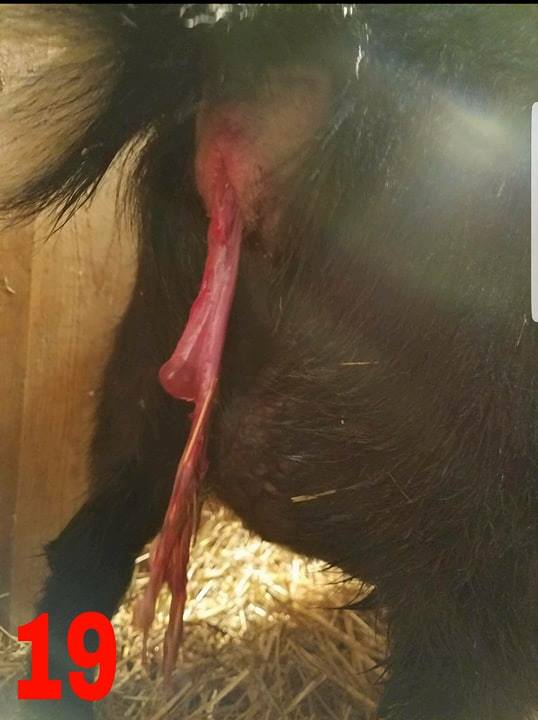
Stage three is the cleaning stage. ( release of the placenta) The doe’s straining decreases as the attachment between the uterus and placenta relaxes and separates. The placenta then is expelled from the doe. The placenta is commonly referred to as the afterbirth. This stage can last from one to eight hours sometimes 24
All three stages should take place with little to no assistance from the caretaker, although some times it is necessary to lend assistance. Generally this assistance will be during stage two of the kidding process. Determination of when assistance is needed is sometimes difficult and usually requires close observation. We will cover difficult births and when to call a veterinarian in Part 2.
Length and variations
Average gestation is 150 days from successful breeding.
Range of 148-155 days is common. Slight deviations out of this time frame are also possible. The more babies that are in there, the earlier they will come. Quads tend to come at the very first part of the range or even earlier as they just run out of room inside. As long as initiated by the fetus and the correct hormones are released to develop lung tissue, the babies can be normal healthy neonates at this age.
A week before your doe is due, it’s best to begin checking on her regularly for labor signs. Some does give little warning, while others can be quite expressive. She may begin to breath heavily, have a worried look on her face, and paw at the bedding. Her udder may appear somewhat shiny and the area above her tail and around her hip bones will appear sunken in. Additionally, she may look back at her sides and “talk” quietly to her in utero babies. She will appear restless as labor progresses and eventually, the contractions will come together more closely and she will begin pushing harder. Does can deliver standing up and lying down, so try to stay out of her way and allow things to progress as naturally as possible.
A normal delivery usually takes five hours. Cervix dilation (which you cannot see) usually requires four hours, and then one hour is required for the delivery of the kids.
It’s that time !!!
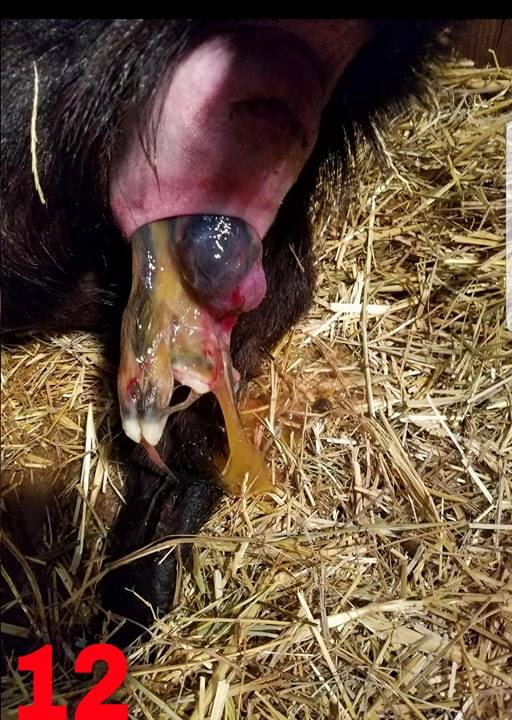
One of the first signs of getting ready to kid is a translucent bubble of fluid.. this is the amniotic sac surrounding the kid which will usually appear first. This does not always occur but is a normal process in the birthing. This sac often ruptures before the kid is expelled. There can be times you will not see the “Bubble” so do not panic !
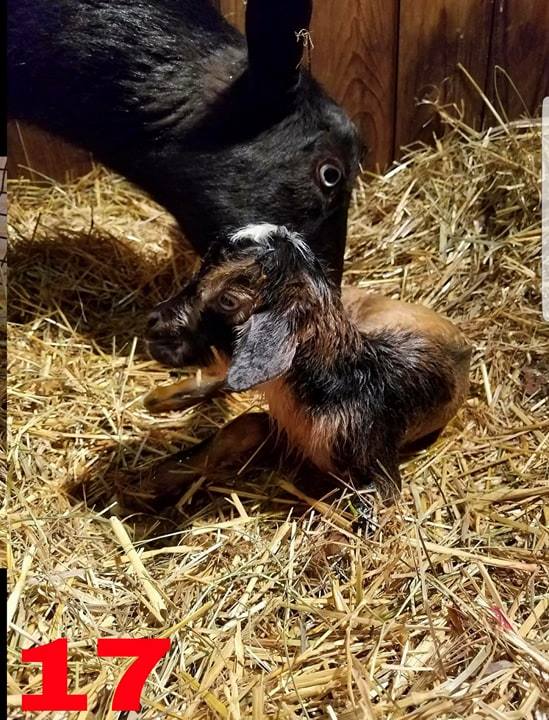
Let’s take the journey through a normal birth ! You will see a number in the lower bottom of each picture below allowing you to see the whole process.


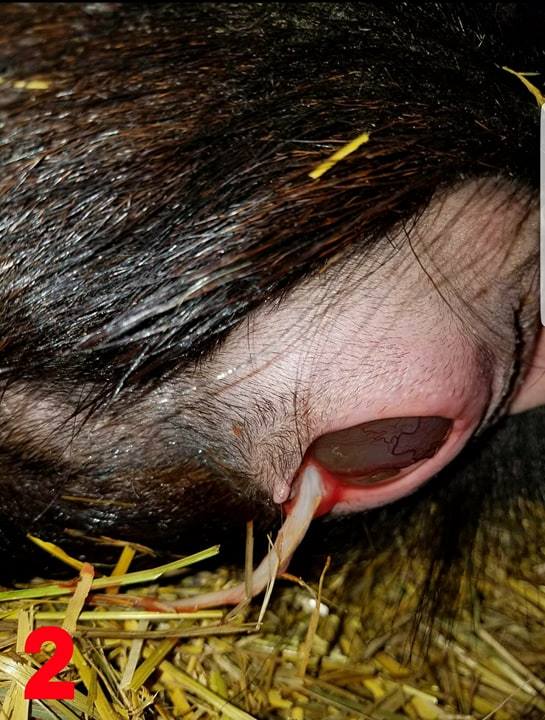


Watch carefully as a kid is starting out the vulva. The picture below shows a single hoof starting to appear head of the other hoof. If you look closely at the hoof, you will be able to tell if the kid will be coming out front first or rear first.


First you will see one foot. You may only see one foot for quite a while, eventually you will see the second. The head appears next resting on the legs, in the “diving position”. Usually the tongue is sticking out, this is normal. ( Don’t panic) The “bubble” can break at any time and it is ok. The head is the hardest part to get out. Once the head is out, the rest of the kid can come out quite quickly.

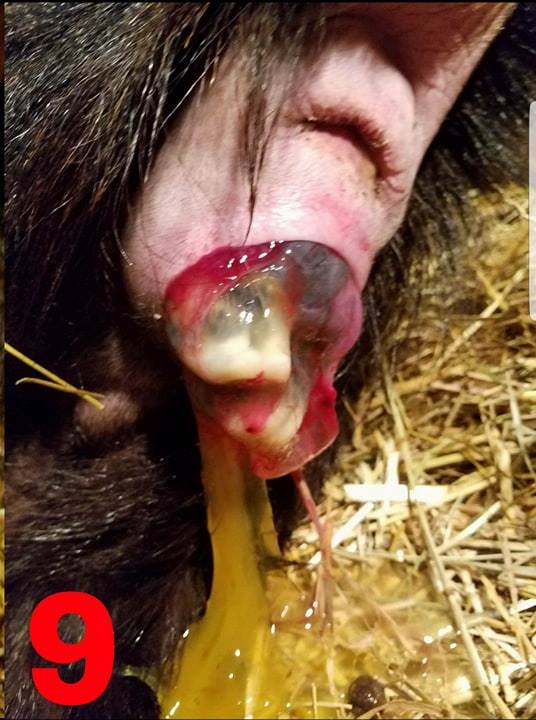


It is normal for the tongue to be seen outside the mouth on a baby during kidding.


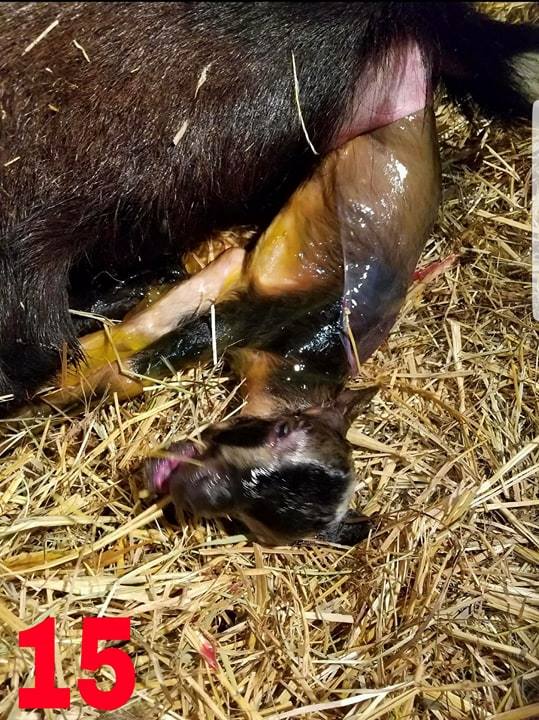
Welcome to the world little one ! Let mom have bonding time.. Do not rush in grabbing new born kids, you can assist by making sure air ways are clear of mucus and check umbilical cord and tie off if needed . If the umbilical cord is too long (over 2 inches), you may need to cut it a little shorter. Tie it off with a bit of dental floss so it will not bleed. Cut as need with scissors dipped in the iodine. and dip end of umbilical cord in betadine solution. Do make sure the doe starts cleaning up the kid , if she does not then lay the kid in front of the doe to allow her to start cleaning up. The doe will nibble at all of the mucus on the kid normally starting at babies head. She needs to be able to clean up her kids in order to identify with the kid. Cleanup may be interrupted by going into labor again with more kids. Watch closely to ensure she does not lay on a kid already born while she tries to deliver other kids. Note.. Does should immediately want to be near their babies, licking the babies, and nudging them as soon as they are born. Does that have had stressful deliveries, first time mothers and does that are very scared around people yet have a crowd present for the event will often leave the babies, shy from them or not be sure of what to do. Does that are scared often just need time alone. Does that are stressed or exhausted often could use a drink of warm water with molasses, some grain for added energy and a nice quiet place to bond with the baby. First fresheners sometimes simply need some help realizing these are their little responsibilities.
Always keep in mind that every doe is an individual and every doe is different.

Importance Of Colostrum
Keep in mind….Newborns…Colostrum is the first milk produced after parturition (the actual birthing process). Colostrum contains a high content of immunoglobulins (anti-bodies), vitamin A, minerals, fat and other sources of energy. Antibodies are proteins that help the goat kid fight off diseases. The ability of kids to resist disease is greatly affected by the timing of colostrum intake and the quantity and quality of the colostrum ingested. The first two hours after birth is the most critical time in which newborns require colostrum. colostrum is thick and heavy and fills a babies small stomach quickly.
More information on the importance of colostrumhttps://www.facebook.com/groups/goatvetcorner/permalink/1912389579007448/
Stage 3….This is delivery of the placenta and the return of the uterus to its normal or pre kidding state. Normal placenta passage should occur in 6 hours sometimes up to 24 hours.

If you don’t find the afterbirth the doe probably ate it…it’s quite normal ! Note…. You will also find a discharge from the doe 1 week to 2 weeks after kidding. This is called lochia it is the vaginal discharge after giving birth, containing blood, mucus and uterine tissue.
Newborns need to eat !
Kids will find the teats and start nursing within a few hour usually. If they can’t find the teats and start nursing within that time period, help them get the teat in their mouth by gently placing them under mama and guiding them to the teat. Kids will want to nurse very often from every 15 minutes to every hour or so when with mom. The kid should appear more alert each time you check. Kids that are humped, quiet or standing off from mom and not curled up content and warm should be examined closer. It may warrant some karo syrup to get energy levels back up to feel like nursing again.
Babies should be checked every few hours during the first 24 hours if possible to make sure they are alert, active and wanting to nurse. Security cameras/ monitors are really helpful for this as well.
Note…. Sometimes the kid(s) will appear to have deformed legs – They may have difficulty standing and/or walking – Typically seen more often with multiple kids, but it can also be seen with really large single kids too. The joints may seem really loose or lax and the kid appears to walk on the backs of the legs, instead of the bottoms of the hooves. The joints may seem really tight or contracted – Kid appears to walk on the fronts of the legs and hooves, instead of the bottoms of the hooves.
The more you try to help, the harder it will be for the kid to figure out its legs and stand….Remember, the kid’s got an HOUR to figure it out on its own… Be patient. They will normally correct itself within a week. You need to ensure the kid is getting the needed nutrition until they can get around on their own.
More information on Bent /rubber legs on newborns https://www.facebook.com/groups/goatvetcorner/permalink/1919903314922741/
Keep in mind The bottoms of the baby’s hooves will “shed” their protective white coating right after birth. This is perfectly normal.. the hoof coating is what protected mom’s uterus as babies came through the birthing canal. The newborn kid will sometimes poop and pee right after birth, even before having first meal. The kid’s first few poops will be soft sticky “black tar”. This is meconium. The kids poop once eating will turn “yellow mustard poops” for at least a week after birth until he begins to eat solid food Pay close attention to the butts of newborn kids, Some mothers are better than others at cleaning their babies butts off and keeping them clean. You may need to clean the kids butts off on occasion. Make sure no hardened poop plugs up their rectum, this can happen and the kid will not be able to poop.

Kidding can be enjoyable but educating yourself and having the correct supplies can be extremely helpful.. It does not matter if this is a first time experience or 50 plus times, each goat and the experience is different. Goat vet corner files have information on kidding, difficult kidding , all about newborns, bottle babies, cold babies, feeding amounts etc.
**The Vet Corner groups encourage members to establish a relationship with their local veterinarian, don’t wait until an emergency.**
© 2014-2025 Rural Veterinary Outreach. All Rights Reserved.
 RVO Vet Corner Files
You must be logged in to post a comment.