by Ken Brown DVM
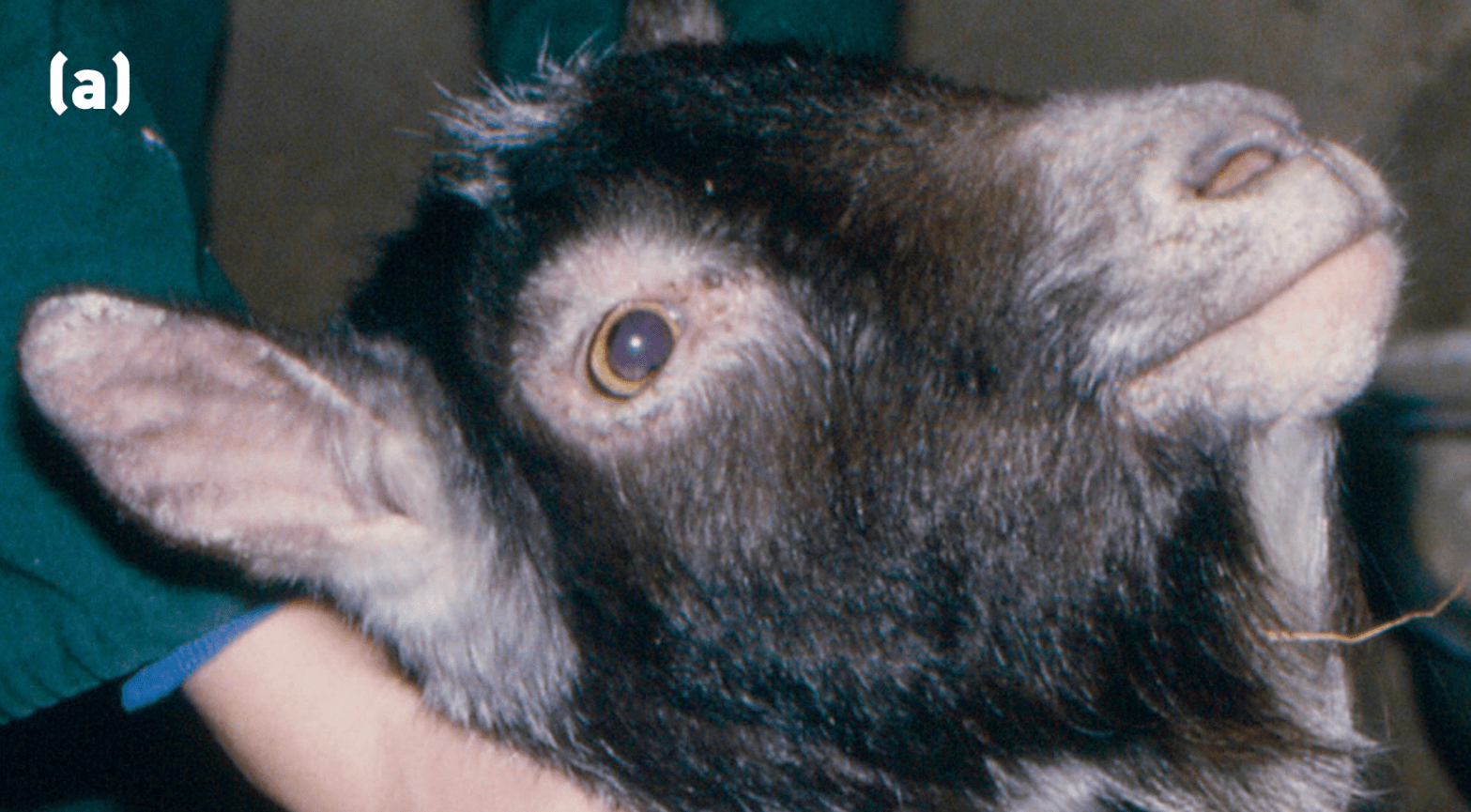
“Why does my goat have hair loss around her eyes?”
Let’s first consider hair in general and how and why it grows the way it grows. When there is a mucus membrane (a moist area) there is no hair naturally, so the edge of an eyelid is not going to have hair. Over the entire body, hair follicles are the “home” for the hair shaft to grow outward, so any disruption of the follicle can disrupt hair growth or cause hair loss. Disruption can be many things, including swelling, blocking or destruction.
Hair has a natural cycle of loss and replacement that lasts about 28 days (from loss to recreation and growth/regrowth). Hair is always being lost and replaced, but when it occurs all at one time, you will see patches of hair loss.
The natural loss cycle can be disrupted with a stress event and the release of hormones (cortisol) as we as some drugs. “Telogen effluvium” is seen in many mammals and is a disruption of hair growth so that a lot of hair is lost at one time vs over a period of time – this leads to baldness and thinning hair until the hair grows back.
Follicle stability and growth can also be disrupted by outside forces such as mites, tears (from the eye), or the body itself (autoimmune). The most common cause for hair loss is going to be a disruption in hair growth and follicle stability..
Any inflammatory cause can disrupt the follicle and cause hair loss or thinning.
Mites cause a mechanical disruption (damage) and inflammation due to the presence and tissue irritation from the mite. The same is true for some chemicals placed on the skin and causing an inflammation and loss of hair. Tears from excess eye irritation over a period of time can cause a hair loss as the protein in tears can irritate the follicles.
A mineral or vitamin deficiency may be implicated, but will usually show more generally – how does a mineral or vitamin know to cause a problem in just one area when the mineral is needed the same throughout the body? A mineral may be needed more in certain areas, but hair growth is pretty systemic, unlike special needs like pregnancy or liver function, etc.
So why is there hair loss around the eyes? I have a list of things to consider and go down my list and treat in this order:
1. Mites – they are under the skin at the follicles as it is softer skin, easier to attack first, and generally moist for a source of water for the mite to reproduce. Mites can be itchy. See 3 below. Younger animals or ones with a weak immune system are more prone to have the problem.
2. Tears – the actual protein in the tears that are generated can irritate the follicles and as one follicle gets inflamed the inflammation spreads to the next follicle and so on until see a “ring” around the eye and extending outward. Irritation from pollen and the eyes tearing more to protect themselves can increase tear production and have more hair loss, with the pattern being more on the bottom and toward the center of the eyes and less hair loss over the eye.
3. Rubbing – primary or secondary to some irritant, including pollen, and the pattern is more loss at the middle and upper areas, with some evidence on the outside edge — the areas that stand out more from the face and are easiest to rub.
4. Gnats – they can irritate the area at the edges of the eyelids very severely as the saliva has protein that is irritating. This can cause a swelling and redness that is sometimes mistaken for early pinkeye. It will also lead to hair loss from inflammation due to the saliva, the tears being produced, and rubbing.
5. Deficiency in a necessary nutrient for hair growth, which can include selenium, copper, zinc, vitamin E, is another cause for hair loss or thinning. A balanced food ration generally will provide the minerals and vitamins needed, so this tends to be less of a problem in a properly managed herd. Individual animals may present with the problem and is a one-animal problem, but if seen in many animals it is best to explore diet and the interference with absorption of minerals via other minerals (phosphorous or iron in the water, for example). Also, the hair loss will tend to be generalized, not just focal to just around the eyes, so this cause is lower in frequency than you would think. If a specific function of the body requires a mineral or vitamin and it is lacking, that can show as a focal problem, but the hair growth around the eyes (or tail) has no more need for minerals or vitamins than any other hair growth. If it were a deficiency of a mineral for hair growth you would expect to see thinning hair in other areas as well, which would then justify a supplement.
“So what about my little baby goat and hair loss around the eye?” Before you worry too much that something is wrong, go back to the section above when we went over hair loss and stress and how it takes 28 days to get hair back into a growth cycle and repairing itself. Babies will often have hair loss around the eyes and it means nothing at all but is a natural state of growth as their bodies adjust. In addition, they can be rubbing the area due to irritation from pollen, or a dusty barn can cause more tearing and some hair loss, gnats may be causing the problem and inflammation and tearing or a reaction to gnat protein/saliva.
Before you inject the kid with a chemical, narrow down what the problem actually is – it may be pollen, irritation, gnats, or just a simple growth pattern. Not all perceived problems are actual problems, and absent itching or spreading, a small area of hair loss is not a major concern.
If the area of concern is moist, crusty, or has a discharge what is white or yellow tinged, there may be a skin infection at play.
In all cases, if it is not a mite problem (I treat it with dectomax, 1cc per 100 lbs, subq injection every 7 days for 2 to 3 injections or more if needed), then be cautious near the eye and focus on safe medications. Eye medications are generally safe near the eye – Terramycin is a good one and can be purchased at Tractor Supply.
**The Vet Corner groups encourage members to establish a relationship with their local veterinarian, don’t wait until an emergency.**
© 2014-2025 Rural Veterinary Outreach. All Rights Reserved.
 RVO Vet Corner Files